Buying a laptop is an important decision, especially when you have a limited budget. Whether you are a student, working professional, freelancer, business owner, or startup founder, having a reliable laptop is essential for everyday work.
However, purchasing a laptop is not always easy. A good laptop can cost anywhere from ₹30,000 to ₹1,00,000 or more. Spending this amount at once may affect your monthly budget.
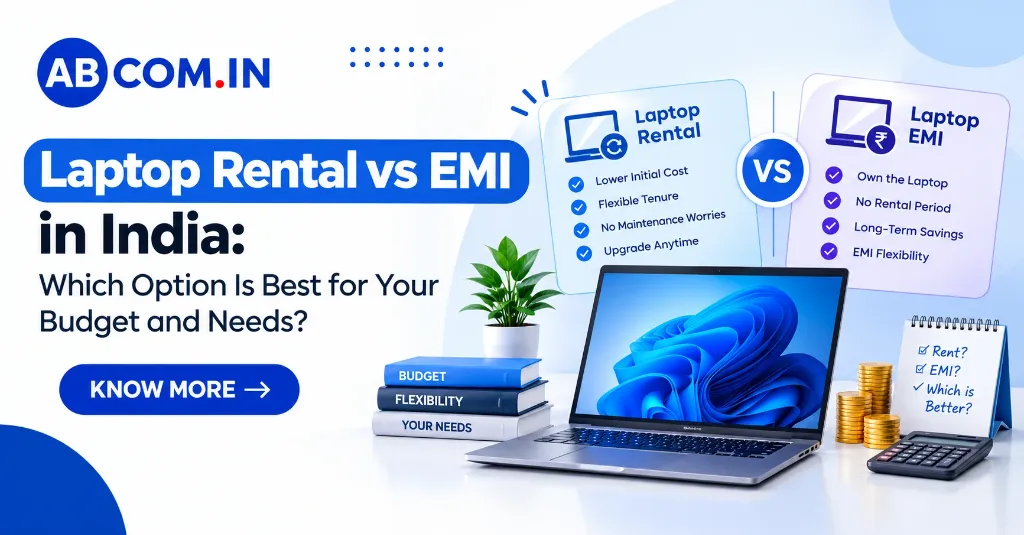
Fortunately, you have two popular options: laptop rental and laptop on EMI.
Both options allow you to use a laptop without paying its entire price upfront. But which one is better for your financial situation?
In this guide, we will compare laptop rental vs EMI in India, including their costs, advantages, disadvantages, and suitability for different users.
What is Laptop Rental?
Laptop rental means using a laptop for a specific period by paying a fixed rental amount. Instead of purchasing the device, you borrow it from ABCom, one of the best laptop rental companies across India, under agreed terms.
You can rent a laptop for a few days, months, or even a year, depending on your requirements. ABCom offers different configurations, including laptops for office work, online classes, programming, designing, and gaming.
Benefits of Laptop Rental:
- Low upfront cost: You generally pay a rental fee and refundable security deposit instead of the complete laptop purchase price.
- Flexible duration: Choose a rental period according to your project or personal requirements.
- Maintenance support: ABCom offers technical assistance and repairs under agreed rental agreements.
- Easy upgrades: You may switch to a better configuration when your workload or computing requirements change.
- No ownership responsibility: You do not need to worry about hardware depreciation or selling the laptop after your work is complete.
However, check the security deposit, damage policy, maintenance coverage, delivery charges, and return conditions before renting.
What is Laptop EMI?
Laptop EMI (Equated Monthly Instalment) allows you to purchase a laptop by paying its cost in smaller monthly installments. You can purchase a laptop through a bank, credit card EMI facility, or eligible consumer financing provider.
For example, if a laptop costs ₹60,000, you might pay the amount over 6, 9, or 12 months, depending on the available financing options. Once all payments are completed, you own the laptop.
Benefits of Taking a Laptop on EMI:
- Ownership: The laptop becomes your permanent asset after completing all payments.
- Flexible payments: Divide a heavy purchase cost into manageable monthly installments.
- Long-term savings: You can continue using the laptop after completing payments without any recurring monthly charges.
- Personal use: You can customize, upgrade, or resell the laptop, subject to applicable warranty terms.
- Suitable for regular users: Ideal for people who need a personal laptop every day for several consecutive years.
However, interest, processing fees, late-payment charges, and other applicable costs can increase the actual purchase price.
Laptop Rental vs EMI in India: Key Differences
Both options provide access to laptops without demanding the full upfront price. However, they differ significantly in ownership, flexibility, maintenance, and long-term costs:
| Comparison | Laptop Rental | Laptop EMI |
|---|---|---|
| Initial cost | Usually lower (rental + deposit) | Down payment / processing fees may apply |
| Monthly payment | Rental fee | Equated Monthly Instalment (EMI) |
| Ownership | No (device returned to provider) | Yes, complete ownership after repayment |
| Maintenance | Covered under agreement (by provider) | Usually user's responsibility (post-warranty) |
| Flexibility | Generally higher (return or extend anytime) | Depends on financing tenure (contract commitment) |
| Upgrades | Often easier (swap for newer model) | Requires buying another new device |
| Best duration | Short to medium term (months to ~1-2 years) | Long term (3 to 5+ years) |
| Reselling | Not allowed | Generally possible at market resale value |
The right choice depends on how long you need the laptop and how much you can comfortably spend each month.
Laptop Rental vs EMI: Which is More Affordable?
Let's understand the financial difference with an illustrative example. Suppose you need a laptop worth ₹60,000.
Option 1: Laptop Rental
Assume the monthly rental starts at ₹849/month (pricing varies based on exact laptop configuration):
- Monthly payment: ₹849
- Six-month cost: ₹5,094
- Twelve-month cost: ₹10,188
- Twenty-four-month cost: ₹20,376
Option 2: Laptop on EMI
Assume you purchase the same laptop for ₹60,000 through a standard 12-month zero-interest EMI facility:
- Monthly EMI: ₹5,000
- Total payment: ₹60,000
- Ownership: Yes
Note: These figures are illustrative and not fixed market quotations. Applicable taxes, deposits, interest rates, processing fees, and delivery charges may change the final cost.
What does this comparison tell us?
If you need a laptop for six to twelve months, renting is substantially more affordable because you avoid spending the full ₹60,000. However, if you plan to use the exact same laptop for three or four years, purchasing through EMI may offer better long-term equity value.
Advantages and Disadvantages of Laptop Rental
Advantages
- Requires significantly less initial investment.
- Suitable for temporary projects, exams, and short-term corporate requirements.
- Allows users to easily swap or upgrade laptop configurations.
- Includes maintenance, repairs, and technical support under rental agreements.
- Helps businesses and startups equip temporary employees without capital expenditure (CapEx).
Disadvantages
- You never own the rented laptop.
- Continuous rental payments over multiple years can exceed the purchase price.
- Security deposits may temporarily tie up available cash.
- Damage or late-return penalties may apply if the device is mishandled.
- Availability of specific high-end models depends on provider stock.
Advantages and Disadvantages of Laptop on EMI
Advantages
- You eventually own the laptop as a personal asset.
- Ideal for long-term personal use spanning several years.
- No recurring rental payments after repayment is complete.
- You can customize software, install accessories, and tune the device freely.
- Ownership gives you the option to resell or trade in the laptop in the future.
Disadvantages
- Interest, processing fees, and GST on interest can increase the total cost.
- Monthly EMI becomes a strict legal financial commitment.
- Repairs and battery replacements post-warranty require out-of-pocket spending.
- Laptops depreciate rapidly as newer CPU generations arrive.
- Missing payments can damage your credit score (CIBIL/credit report).
Which Option Is Best for Different Users?
1. Students
Laptop rental can be useful for students who need a device for a short semester, certification course, exam preparation, or temporary academic project. EMI may be better for students who need a durable personal laptop throughout their 3–4 year college degree.
2. Working Professionals
Professionals who work remotely on a permanent basis may benefit from purchasing a laptop through EMI. Those working on temporary freelance contracts or awaiting company-provided equipment can consider renting.
3. Freelancers
Freelancers with changing project requirements (e.g., needing higher GPU specs for 3 months) benefit from rental flexibility. For consistent, predictable everyday administrative work, buying via EMI may be more economical.
4. Startups and Businesses
Laptop rental helps startups equip growing teams, contractors, and interns without large upfront capital expenditures. Businesses can treat rental payments as operational expenses (OpEx) for tax deductions while avoiding maintenance overhead.
5. Gamers and Content Creators
If you need a high-performance laptop for gaming, video editing, or graphic design, EMI may be suitable for long-term personal ownership. Renting is a practical alternative for testing a configuration or working on a short-term video production project.
Important Things to Check Before Making a Decision
Before choosing between laptop rental and EMI, evaluate these critical factors:
- Total Cost: Compare the cumulative rental charges with the laptop's outright purchase price and financing fees.
- Duration: Calculate how many months or years you realistically need the device.
- Maintenance: Understand whether repairs, routine servicing, and accidental damage are covered by the provider or your own wallet.
- Specifications: Choose hardware (CPU, RAM, SSD, GPU) that comfortably meets your workload requirements.
- Hidden Charges: Check processing fees, refundable deposits, applicable taxes, delivery costs, and foreclosure charges.
- Financial Stability: Never commit to an EMI that strains your monthly emergency savings or essential living budget.
For financed purchases, carefully review the lender's Key Facts Statement (KFS), Annual Percentage Rate (APR), repayment schedule, and applicable late fees.
Need a Laptop Without the Heavy Upfront Cost? Choose ABCom!
Still confused between laptop rental and EMI? If you need a reliable laptop without making a large upfront investment, ABCom makes it easier to get the right device for your needs and budget.
Whether you are a student, working professional, freelancer, or business owner, ABCom offers flexible rental solutions with multiple laptop configurations to support your requirements. Choose Laptop on rent with ABCom and enjoy flexibility, affordable rental plans, and prompt technical support as per your rental agreement. Don't let budget limitations slow down your work—get the right laptop at the right time with ABCom!
Frequently Asked Questions (FAQs)
1. Is renting a laptop cheaper than buying on EMI?
Renting is generally cheaper for short-term requirements (under 12–18 months). However, buying through EMI may offer better value when you need the laptop continuously for several years.
2. Can I rent a laptop for one month in India?
Yes. ABCom offers monthly rental plans. Availability, minimum rental duration, and deposit requirements depend on the chosen laptop configuration.
3. Is buying a laptop on EMI a good decision?
Yes, if you need the laptop for long-term personal use and can comfortably afford the monthly payments without disturbing essential savings or living expenses.
4. Can I upgrade a rented laptop?
Many rental companies like ABCom allow configuration upgrades or device replacements, depending on device availability and contract terms.
5. Which is better for a startup: laptop rental or EMI?
Rental is generally better for startups managing fluctuating team sizes and conserving working capital as an operational expense (OpEx). Purchasing may be more economical for core permanent staff.
Final Verdict: Laptop Rental or EMI?
The choice between laptop rental and EMI in India depends on your budget, usage duration, and financial priorities:
- Choose laptop rental if you need flexibility, want to avoid a large upfront expense, need included maintenance, or require a laptop temporarily.
- Choose a laptop on EMI if you want asset ownership, need a personal device regularly, and plan to use it for three or more years.
Before deciding, calculate the total cost of ownership across your expected usage duration rather than comparing monthly figures in isolation. The smartest financial choice is the one that meets your productivity goals without placing unnecessary pressure on your monthly budget.